Yes they do but it’s expensive. An additional $4.80/mth cdn. So I got the mid range package which worked out to just over $165 for 27 months. That’s $6.15 cdn/mth then $4.85/mth for a dedicated IP. That’s $11/mth. So I passed on the dedicated IP address as I don’t have any issues using their regular servers.
I don’t see how that’s possible considering that to have a static IP you have to be “identified” to make that happen. A static IP is good for allowing more access to more Sites you might not otherwise be able to but it comes with even more privacy cost.
Surfshark, NordVPN and ExpressVPN all employ multiple trackers as soon as you open their apps/software.
They may state they are tracking your online activities “anonymously“ but are they…who knows?
I don’t know why a VPN company would even offer this if it wasn’t anonymous.
Here are the screenshots in my account that shows this. I haven’t completely setup my dedicated IP address yet but these are the options that it provides to make it anonymous.
This is a great feature of Surfshark and many others don’t have it.
This will delete any information we have in our database that identifies you as the owner of your Dedicated IP address.
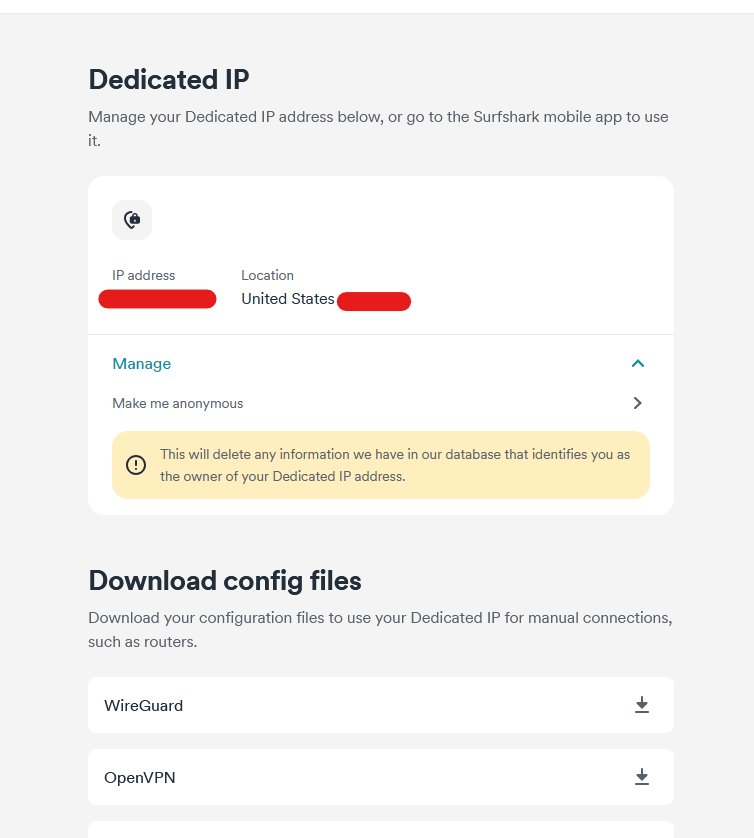
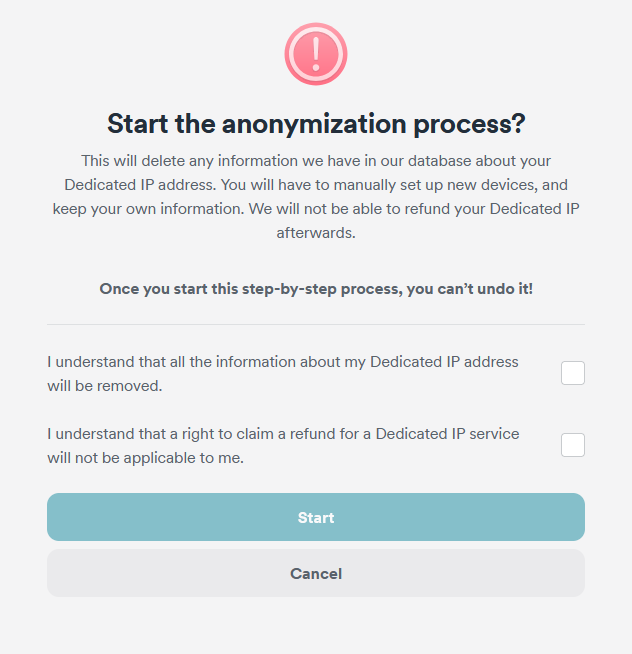
Sorry, meant config files. See my images below which shows what happens after purchasing a dedicated IP Address. You have the ability to anonymize it.
AWESOME TIP!!! Will definitely do a video on this and give you credit for this tip. THANK YOU!!!
I got an update for you. I saw your post earlier about Surfshark’s Dedicated IP feature allows users to make their dedicated IP anonymous by unlinking it from their email address. This process involves saving a unique token and then removing the token from the Surfshark site. I ended up doing this now on new fire stick its requiring me to input token and I am unable access the box where you enter the token. Previously before removing token, it pulled in the Dedicated IP after logging out then back in to Surfshark.
A “static” address is unique to it’s user and easier to track to that single user where shared IP’s are used by multiple users and more difficult to track back to a single user.
Using VPN’s for anonymity is dependent on the provider for that anonymity.
If you have to give personal info to signup with them (email address, payment info, etc.) or for any other services they provide, then you are in their system.
The provider may state that the use of a “token” or “key” makes you anonymous but the act of entering that in their app probably is recorded somewhere in order for anything to happen.
As stated previously, if you use Surfshark, NordVPN, ExpressVPN (and some others) they track your online activity as soon as you open their apps/software. None of these companies state that they use trackers (like Google Crashlytics, Google Firebase Analytics, AppsFlyer, etc.) in their apps/software to track online user activity.
That, to me, is a huge red flag, especially since these VPN providers boast of providing privacy, anonymity and security!
Audits done by reputable companies like Deloitte debunk your claims regarding Nord tracking of customers online activity.
I somehow got to the token field and was able to manually enter the token using Amazon Remote App. Then I deleted the Surfshark app and reinstalled app but was unable to add the token again. I guess best advice is don’t remove the token from Surdshark site until you have all your devices setup.
Thanks for this information.
I will reach out to them to see if it’s even necessary to go through the anonymization process.
Did those audits include doing data recording of their apps/software?
Surfshark (to their credit) confirmed the use of the trackers stated on the above website.
NordVPN, on the other hand, repeatedly denied the use of trackers until the owner of the that site published evidence to the contrary.
NordVPN finally admitted that they do indeed use the trackers that the article stated they use.
”As described in our response, there was miscommunication on agent’s part, and we do not deny the use of trackers.”
ExpressVPN also denied using the trackers stated on that website.
If you want to understand about audits then google is your friend. Deloitte has absolutely nothing to do with Nord. They clearly state that no data tracking, addresses or personal info is recorded. Audits are vital to ensuring VPN policies, as stated by those companies are true and honest.
From the audit:
Key Takeaway
NordVPN is designed to keep your online activity private and untraceable. It follows a strict no-logs policy, meaning it doesn’t store your IP, browsing history, or session data.
Based in Panama, NordVPN isn’t subject to data retention laws, and this privacy promise has been audited and verified by Deloitte.
Features like AES-256 encryption, IP masking, Threat Protection Pro, and Double VPN further shield your activity from ISPs, hackers, and trackers.
Even if legally asked, NordVPN has no user data to hand over. For anyone concerned about tracking, NordVPN offers peace of mind and true anonymity online.
I read the report you refer to and it’s the same as most other VPN services. No on line activity is kept so no data to turn over as your activity is not tracked or kept. Of course they need to process payments and make sure you are getting the service you pay for, so naturally they need your payment info and an email address etc. Use an alias email for added security. But if they are not tracking what you are doing on line then there is nothing for the authorities to refer to and nothing to specifically “turn over”, and certainly nothing to point directly to you.
I wouldn’t waste any more time arguing this point. More than likely a paid troll thru copyright company. Vpns are main line of defense for people who want to download or stream torrents and these companies know they can’t do anything to find these people unless they aren’t using vpn.
Thank you for sharing Troypoint’s information on VPNs. After reading the section “None of these companies state they have trackers” takes you into a different world of why you can/can’t trust their marketing. Therefore, more thinking is needed.
Google isn’t my friend. I stay as far away from them as possible 
As I pointed out, NordVPN admitted using the the trackers stated on that IT-Security website after being confronted with the evidence showing they did. The VPN services that employ trackers on their customers absolutely use the information they collect for whatever reasons, otherwise they wouldn’t pay for the use of those services. Deloitte didn’t do data recording of their app/software, or if they did, they didn’t disclose the use of the trackers by NordVPN.
The below is a good description of a “VPN audit”.
“You can think of this like a woodland creature walking by a trail cam: You get a snapshot of the animal at a single point in time, but you don’t know what the critter is doing the rest of the day. VPN audits typically only look at a brief moment out of the entire year. Although VPN audits aren’t perfect, they’re important trust signals, and better than no audit at all.”
VPN service providers generally have servers in multiple countries which may have different laws regarding access to those servers.
NordVPN, like other providers, has previously had breaches, and granted access to their servers for monitoring, etc., to law enforcement.
“Of course they need to process payments and make sure you are getting the service you pay for, so naturally they need your payment info and an email address etc.”
Not necessarily so. I and thousands of others, use VPN services that require no personal information for using their services, such as ProtonVPN, MullvadVPN, and others.
The anonymity part that VPN providers claim while using trackers to track user activity is another conversation. I’m merely pointing out the “contradiction“ of VPN’s who promote privacy, security, and anonymity while using Google and other trackers to track their users activity, stated in Kuketz IT-Security’s summary (translation a little off).
“VPN apps with trackers are not just a contradiction, they are a tangible breach of trust. Instead of strengthening security, they create additional attack surfaces, weaken the already fragile protective effect and make privacy a bargaining ground. If you want to seriously offer protection, you have to categorically do without tracking. Everything else – well-sounding promises of »Privacy« and »Security« included – is nothing more than eye-wiping and marketing fog candle.“
I don’t know the company that wrote that nonsense or who the reporter or creator of that article is and it’s just fake news. Nord has a number of independent audits by reputable and well know companies. Deloitte being just one. Companies that are trusted. As I said there isn’t any tracking or recording of individuals on line activity so absolutely nothing to hand over even should they get a legal court order to do so. I’m not going to do this dance with you any longer. Anyone can pull up conspiracy theories but never from a genuine organization that actually does the auditing. I just quit my Proton Sub I have had for 3 yrs, and I know first hand that they take personal payment info, but like Nord, do not track on line activity. So again, nothing to hand over. The following is the intro to the latest audit.
At the end of 2024, NordVPN commissioned Deloitte Audit Lithuania — an independent team of researchers — to perform an assurance report on the configuration of our IT systems, supporting infrastructure, and no-logs claims. For the fifth time, it was verified that NordVPN’s no-logs statement is accurate and in line with the company’s privacy claims.
As I mentioned, they do have my personal info for payment, buying a VPN isn’t illegal, but so what, as my online activity is not recorded and is encrypted and there aren’t any logs to turn over or info that can be directly confirmed to be coming from, or initiated by me. it’s mute.
The article author is Moe Long.
Is the below that he wrote the “fake news” you’re referencing?
”Deloitte performed its assessment of NordVPN’s infrastructure at the end of 2024, following up audits in 2018, 2020, 2022 and 2023, making this Nord’s fifth no-logs audit. In its assessment, Deloitte found no evidence of logging. I appreciate Nord’s ongoing commitment to yearly audits, a trend I hope continues.”
I just quit my Proton Sub I have had for 3 yrs, and I know first hand that they take personal payment info, but like Nord, do not track on line activity
Yes, Proton allows for different methods of payment for using their services, including using them without providing any personal information as I stated previously (I’m a Protonmail and VPN user).
Proton also uses Sentry tracker unlike NordVPN which uses the 3 trackers mentioned previously.
my online activity is not recorded and is encrypted and there aren’t any logs to turn over or info that can be directly confirmed to be coming from, or initiated by me. it’s mute.
This a “fuzzy“ narrative, IMO, that VPN companies use for promoting their services and almost all do. VPN’s are in business for one reason only and that is to make money.
No VPN companies that I have used state that they use tracking software in their VPN apps/software whether they do it anonymously or not. That would throw up red flags for many people and be reflected in their bottom line.
Using trackers doesn’t mean they don’t have other good policies in place when using their services, it just means they aren’t being forthcoming on what info they are tracking on their users.
BTW, NordVPN updated their PP yesterday and now state the use of trackers while using their services.
No. 3 Sharing Your Personal Data (I wasn’t allowed to post a second link to it).
A couple of interesting statements in that policy…
SUMMARY: In some cases, we may need to share personal data with certain third parties, such as trusted service providers, partners, and other Nord group companies. In all cases, we make sure to handle your data safely and respect your privacy — even when it needs to be processed outside of your country.
Nord partners. Sometimes our partners, for example, distributors, resellers, and app store partners, will be independent data controllers of your personal data. In such cases, the procedures established by them (e.g., terms of service and privacy policies) will apply to such relationships. In other cases we may collaborate with partners as joint controllers meaning that we jointly define the purpose and means of data processing with them. Both joint controllers are then responsible for the data processing and its compliance with applicable privacy laws.
Again, a report by someone who just wants to sow dissent, not a reputable and reliable source recognized by internet experts throughout the world. Ones with skills and knowledge in the field. There’s a reason that only 5 firms worldwide are recognized and respected for their “Independent” expertise and whose audits are impartial as they stand to gain nothing by providing false or misleading info. I could copy and paste all sorts of supporting info but you insist on providing conspiracy theories. Your very last quote supports exactly what I said, and states absolutely nothing about on line activity. So if there is nothing to see, noone knows exactly what you are doing while using a VPN, then there is nothing that can be used against you in any supposed prosecutable offence. So the VPN encryption has done it’s job. Once again it isn’t illegal to purchase and use a VPN.
As I said I am not carrying on as this no longer supports the original intent of the thread. Anyone can perpetuate myths and misinformation. Use a VPN or don’t, that’s what freedom is all about, choices. GL2U.